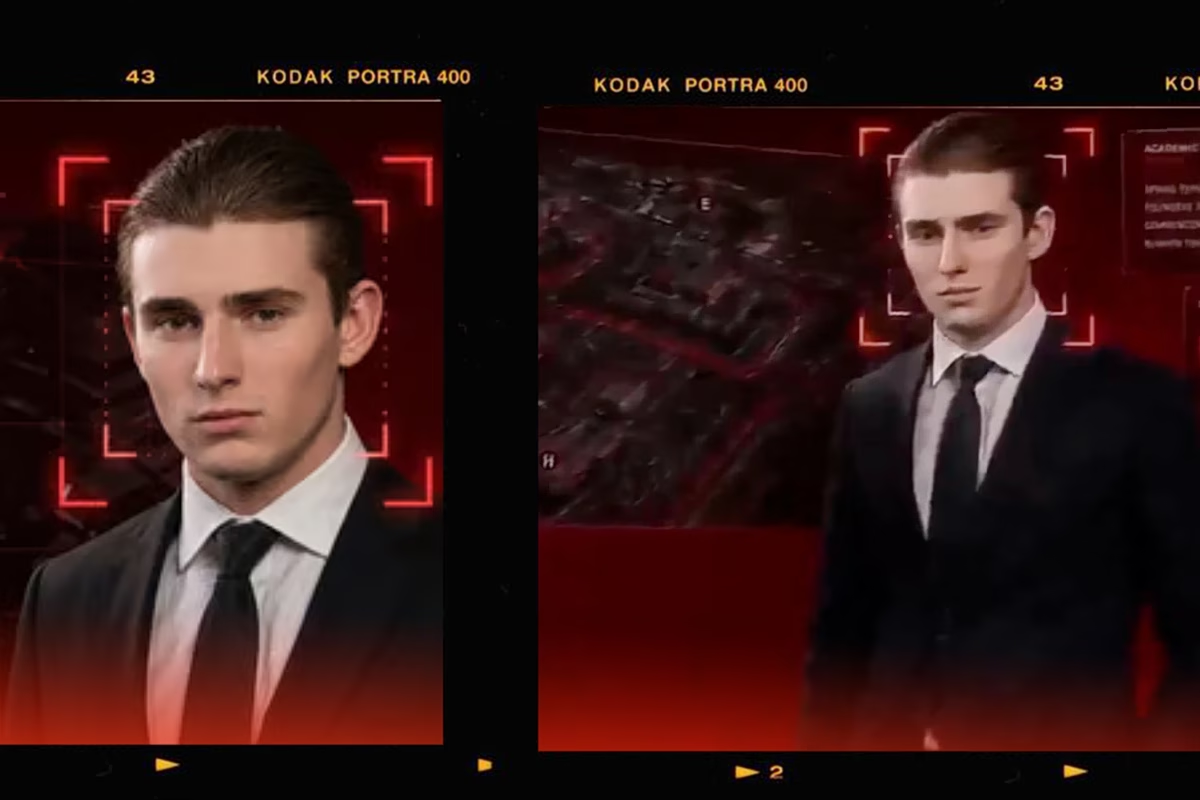
Iranian State Media Targets Barron Trump in Provocative Broadcast
In what observers are describing as a significant and deeply troubling escalation in the ongoing tensions between Iran and the United States, Iranian state television recently broadcast a video that explicitly targeted Barron Trump, the 20-year-old son of U.S. President Donald Trump. The broadcast included messaging that reportedly placed a bounty of $10 million on the young man, marking a stark and alarming development in the psychological and media warfare being waged between the two nations.
The video, which aired on Iranian state-controlled television channels, was widely condemned by U.S. officials and international observers alike. It represents what many consider to be one of the most direct and personal threats made by Iranian state media against a member of the U.S. president's immediate family in recent memory. The move is seen as part of a broader campaign by Iranian authorities to apply psychological pressure on Washington amid heightened geopolitical tensions.
A Pattern of Escalating Rhetoric
The broadcast did not emerge in a vacuum. For several years, Iran and the United States have been locked in an increasingly hostile standoff, fueled by disputes over nuclear negotiations, regional influence, economic sanctions, and a series of military and diplomatic confrontations. The assassination of Iranian General Qasem Soleimani in 2020, ordered during Trump's first term, remains a deeply sensitive flashpoint for Iranian authorities, who have repeatedly vowed retaliation against those they hold responsible.
Iranian state media has, on multiple occasions, made provocative statements and aired content designed to intimidate or unsettle American leadership. However, directly naming and targeting a president's child in such explicit terms represents a noticeable and deeply unsettling shift in tactics. Security analysts have noted that such broadcasts serve multiple purposes: they are intended to generate domestic support within Iran, demonstrate resolve to regional allies, and signal to Washington that no aspect of its political leadership is considered off-limits in Iran's information warfare strategy.
Reactions From U.S. Officials and International Community
The video quickly drew sharp condemnation from across the political spectrum in the United States. Government officials characterized the broadcast as a direct threat to a private citizen and called on international bodies to hold Iran accountable. The U.S. Secret Service, which is responsible for protecting members of the president's immediate family, declined to comment on specific security arrangements but confirmed that protective protocols remain continuously under review in response to evolving threats.
Beyond Washington, international voices also weighed in. Human rights organizations noted that regardless of the geopolitical context, targeting a young adult who holds no official government position is a violation of basic norms governing even adversarial state conduct. Some European governments expressed concern over the broadcast, urging Iran to exercise restraint and warning that such provocations only serve to deepen existing divisions and reduce the possibility of meaningful diplomatic engagement.
Iran's Strategic Use of Information Warfare
Experts in Middle Eastern affairs and state-sponsored media have long observed that Iranian authorities use their state broadcasting infrastructure as a tool of strategic communication, both for domestic audiences and as a channel through which to deliver messages to foreign governments and publics. The Barron Trump video fits within this broader pattern, even as it crosses lines that many analysts say should not be crossed.
According to regional security experts, the explicit targeting of a president's family member is designed to provoke an emotional reaction, test the limits of American resolve, and potentially drive wedges between different factions within U.S. political circles. At the same time, it signals to Iran's own population that its leadership is willing to take a confrontational stance against what it characterizes as American imperialism and aggression in the region.
The Broader Context of U.S.-Iran Relations
Relations between Washington and Tehran have been strained for decades, dating back to the 1979 Islamic Revolution and the subsequent hostage crisis. In more recent years, the breakdown of the 2015 nuclear agreement — formally known as the Joint Comprehensive Plan of Action — and the reimposition of sweeping U.S. sanctions have driven the two countries further apart. Periodic rounds of indirect diplomacy have failed to produce a lasting breakthrough, leaving both sides in a state of sustained mutual hostility.
The Trump administration's current posture toward Iran has been characterized by a maximum pressure approach, combining economic sanctions with diplomatic isolation and occasional military signaling. Iran, for its part, has responded by expanding elements of its nuclear program, increasing its support for proxy forces across the Middle East, and intensifying its information and psychological operations against U.S. interests and personnel.
Security Implications and Protective Measures
The direct naming of Barron Trump in an Iranian state media broadcast raises immediate questions about the security arrangements in place for members of the first family. While children and young adults connected to sitting presidents have historically been afforded strong protection, the evolving nature of threats — including those originating from state-sponsored actors operating across international borders — presents ongoing challenges for protective services.
Security professionals emphasize that the most dangerous aspect of such broadcasts is not necessarily their direct operational impact, but the potential they have to inspire or encourage independent actors who may seek to act on the stated bounty. The spread of such content across global social media platforms means that its reach extends far beyond the audiences of Iranian state television, amplifying the potential risk it poses.
What Comes Next
As tensions between the United States and Iran continue to simmer, the international community will be watching closely to see how both governments respond to this latest provocation. Diplomatic channels remain limited, and the prospect of direct dialogue between Washington and Tehran appears remote in the current climate. Whether this incident triggers further escalation or prompts a recalibration of tactics on either side remains to be seen.
What is clear is that the psychological and informational dimensions of the U.S.-Iran confrontation are intensifying, with ordinary boundaries and norms being tested in increasingly provocative ways. The broadcast targeting Barron Trump has drawn a line that most observers agree should never have been crossed, raising urgent questions about accountability, international norms, and the future trajectory of one of the world's most consequential geopolitical rivalries.